The Burgdorffs at the „Brüdernhof“ in Lafferde
The Burgdorffs at the „Brüdernhof“ in Lafferde
The family tree is rooted in the year 993 — Even relatives from America studied the unbroken line of ancestors
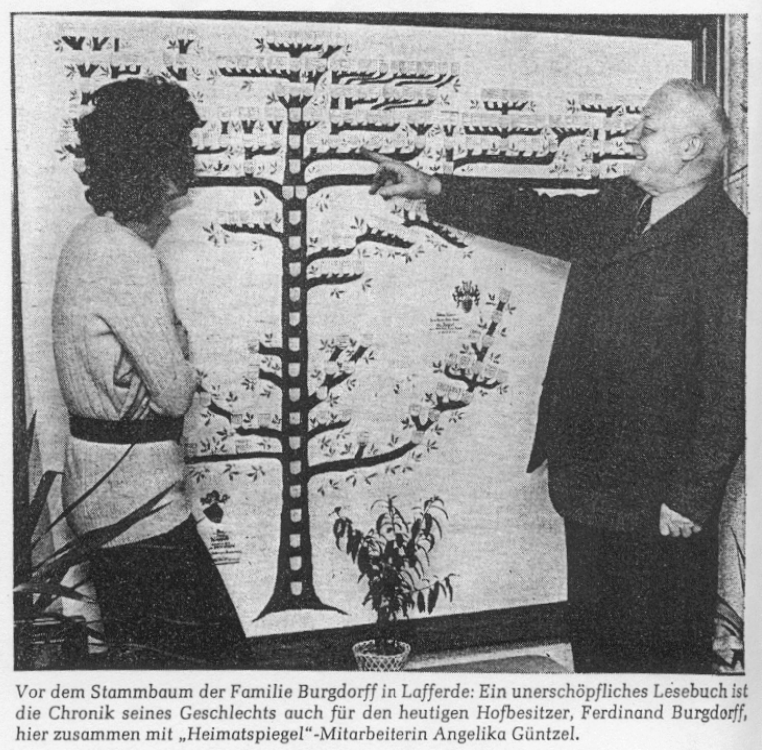
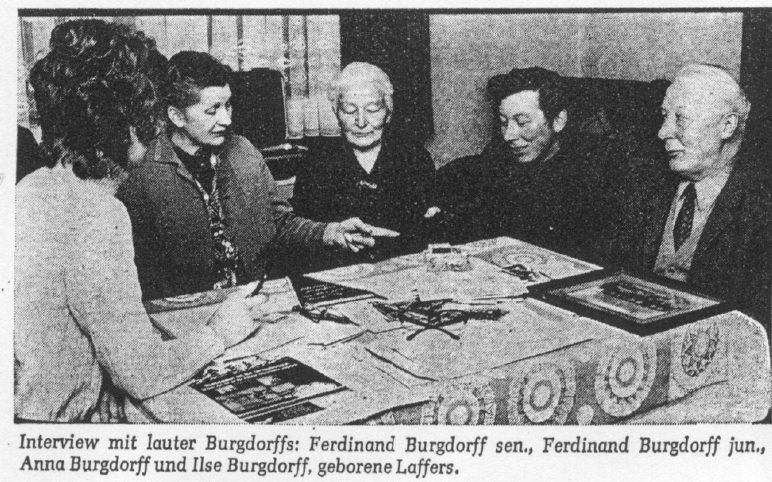
The „Brüdernhof“ is located in the centre of Groß Lafferde. Few locals are familiar with the name, and yet it refers to a small local history sensation: it belongs to an estate that has a thousand-year history. The Burgdorffs have lived here for several centuries, and if you want to find out who they are, you won’t get any further without knowing the proper house number. In the immediate neighbourhood alone, there are six families of this name with f and „ff“. The complicated family relationships can be discovered in the house of Ferdinand Burgdorff, farm no. 38, or more precisely: in the hallway. Here, a huge family tree behind glass fills almost an entire wall, drawn with remarkable care. The symbolic oak tree with its thick trunk and lush crown contains the data of a clan that can trace its ancestors in direct succession back to the year 993. Retired rector Richard Wolff, who has been working through Lafferde’s village chronicle as a hobby for 20 years, has written down the history of this farm and its widely ramified clan. It will appear as a series in the Heimatspiegel. We took this interesting chronicle as an opportunity to visit the current Burgdorff family.
Visitors are not uncommon in the spacious hallway of the renovated farmhouse. Since the family tree was given its place of honour there in 1959, closer and further relatives have been coming in time and again to wander from branch to branch, looking for the names of uncles and great-grandfathers, to look at the family tree and to look for their own names (or ancestors) in this large family clan.
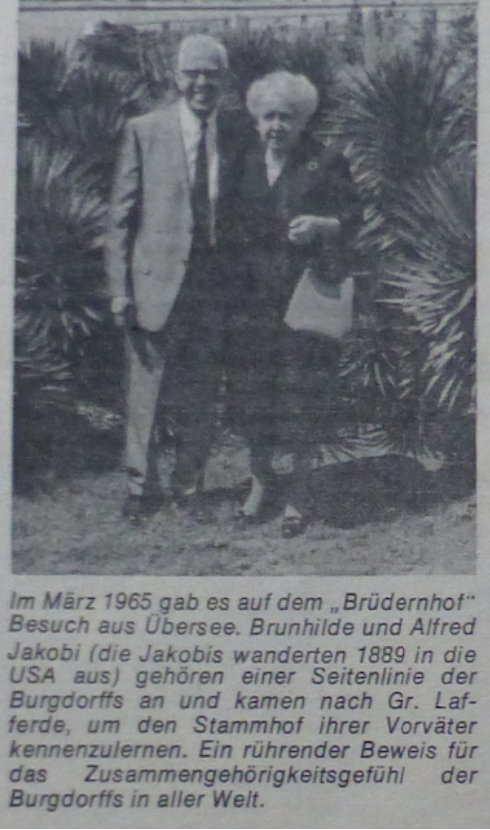
Burgdorffs from Berlin, Hamburg and England stood there, and a visitor from America also benefited from this precision work. Engineer Ferdinand Jakobi from New Orleans, whose great-grandfather was Pastor Burgdorff in Rüper, found this family tree simply fabulous during his visit twelve years ago and had brought along the family tree of the American collateral line, which he had researched himself, to supplement the family history.2
There are many Burgdorf(f)s between Harz and Heide. The trunk of the Lafferde family lies in the area of Braunschweig. Only since the existence of the church records has it been possible to draw on such detailed information. It is certain that the first Burgdorff lived on the „Brüdernhof“ in 1576. The first fire insurance list („Brandversicherungsliste“), which was drawn up for Lafferde in 1777 and contained house numbers for the first time, mentions 15 farm owners with this name, 50 years later there were already 40.
The first name of the original owner is also part of the family tradition. In 1793, the first Vollspänner (i.e. a farmer with at least one horse and cart plus a large area of farmland) Ferdinand Burgdorff is mentioned. Since then, the line of Ferdinands has continued, and only the father of the current owner made an exception with the combination “Emil Ferdinand”.
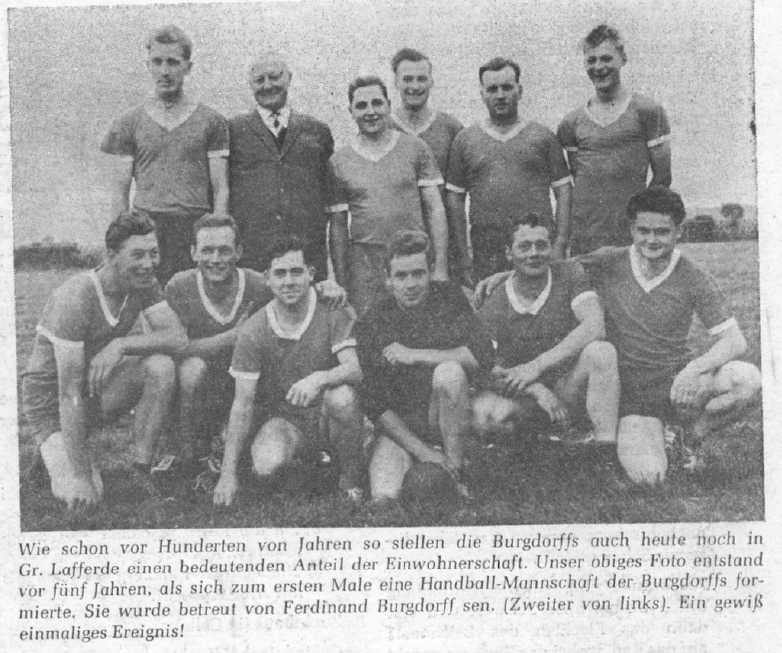
When talking about the Burgdorffs of our generation,3 sport should not go unmentioned. Ferdinand Burgdorff senior, 61, who runs the family farm with his 29-year-old son Ferdinand, was an active footballer, gymnast and handball player for a long time. And he is a horse lover. He used to keep a few horses himself, but now horse races in the vicinity are a firm favourite.
His five children are no less keen on sport, especially handball. As a family team, the Lafferder Burgdorffs even pitted this talent against the district handball champions five years ago. A pennant bears witness to another unusual game: on 5 March 1967, the Burgdorffs played against another family team, the grandsons of the former mayor (Vorsteher) Behrens from Lafferde. It happened that TV almost came for the occasion to make and film a report on this event, but they didn’t in the end.
So much family spirit and history and yet there have never been any major clan reunions. Only the family tree is a central meeting point for relatives from time to time. Incidentally, the Burgdorffs have a Lafferder to thank for their family tree drawn. Jochen Lampe, a nephew of the master miller Lampe (and of course, also related to the Burgdorff family himself), who studied in Göttingen and wrote his doctoral thesis on the Hanoverian nobility, was interested in the history of the farm. In 1952 he collected the first data and in 1959 the huge family tree drawing was completed. Anna Burgdorff, the farm owner’s sister and “guardian of tradition”, received it as a gift for her 60th birthday.
In Gr. Lafferde for 1000 years
The history of the „Brüdernhof“ — The monastery brothers from Hildesheim used to visit regularly
V mansi in decim cum curia zu Laffordi shall be consecrated to St Michael after my death according to my decision.
These are some of the words found in the old records of St Michael’s Monastery in Hildesheim from 1321 and in the will of Bishop Bernward dated 1 November 1022, which was confirmed on 4 November of the same year by a golden seal of Emperor Henry II.
The Latin text means that in Lafferde the tithe (in decim) of 5 hooves of land (V mansi, i.e. about 75 acres4) and a farm lot5 (cum curia) was bequeathed to St Michael’s Monastery in Hildesheim. This monastery was the favourite foundation of the famous Bishop Bernward (993–1022). It was to be his inheritance and also his final resting place.
Bernward, who probably came from ancient Saxon nobility, had amassed an enormous amount of land and property during his time as bishop in addition to his inherited estates. At the end of his life, however, he renounced all earthly riches in order to attain salvation for his soul. With the consent of Emperor Henry, he bequeathed all his possessions to the new monastery he had built. This “dowry”, as he called it, totalled 466 hooves (about 15 acres each), 10 local tithes (from estates), 10 mills and 13 churches with their tithes.
This provided the monastery with a wealth of land, as it now owned small and large farms, mills, churches and estates in almost every village in the diocese of Hildesheim. The aforementioned farm in Lafferde with its five hooves, another farm with 6 hooves (Capellenhof6), the Schliermühle7 on the Fuhse and an unspecified number of Lathöfen8 (Köthern) with 150 acres are also included.
The history of the „Brüdernhof“ in Gr. Lafferde (II)
The early Middle Ages — The farm was directly subject to the Bishop of Hildesheim
The abbot of the monastery and his monks (the brothers) administered the income (the tithe) and expenditure (maintenance of the monastery, churches and mills), regulated the ownership of their Laten, issued new feudal letters (Meyerbriefe) on the death of a Laten and settled the frequent lawsuits and disputes of their “subjects” in these times of legal uncertainty.
Despite the already enormous property, the monastery’s holdings continued to increase over the following centuries. Old records tell of numerous purchases and sales, pledges and the honouring of pledges. In 1175, Provost Gerhard bought five hooves in Lafferde for 29 marks, and in 1303 Abbot Heinrich von Wendhausen bought four hooves and in 1317 from Knight Ludolf von Lengede one Kothhof including land for 73 Mark in pure silver.
St Michael’s Monastery attached great importance to the acquisition of the bailiwick rights, the secular jurisdiction, and did not shy away from very large expenditures for this. In 1303, for example, Duke Albrecht von Braunschweig was paid 100 marks in pure silver for the bailiwick “over 22½ hooves in großen Lafferde, which Knight Rotcher and squire Johann, sons of Willekin von Gustedt, had left to him”. As this purchase will also have included the “5 mansis” of the „Brüdernhof”, the monastery also became the competent secular lord of the manor. Bishop Siegfried II notarised the purchase in 1308.
From this time onwards, St Michael’s Monastery often held “a real and proper Meierding” in Lafferdi, at which local matters were settled, disputes resolved and feudal letters issued.
Even in the early Middle Ages, there were three feudal farming communities in Groß Lafferde, known as villications. The lords of the villications were St Michael’s Monastery, the cathedral chapter and Hildesheim’s cross monastery. There were also individual larger farms that were subject to other feudal lords and were leased out by them, the German term is „vermeiert”. Hence the name Meierhöfe. The Brüdernhof was one of these. As Wilhelm Baumgarten,9 who has long been involved in the history of Groß Lafferde, has established, it has always been under the direct control of the bishop or his prince-bishop’s court chamber.
This farm can be described as the ancestral home of the Burgdorffs since around 1600 (according to the church register). However, it probably existed much earlier, because even if it is not possible to give an exact date for the beginning of the village settlement, it is undisputed that Groß Lafferde already existed in pre-Christian times.
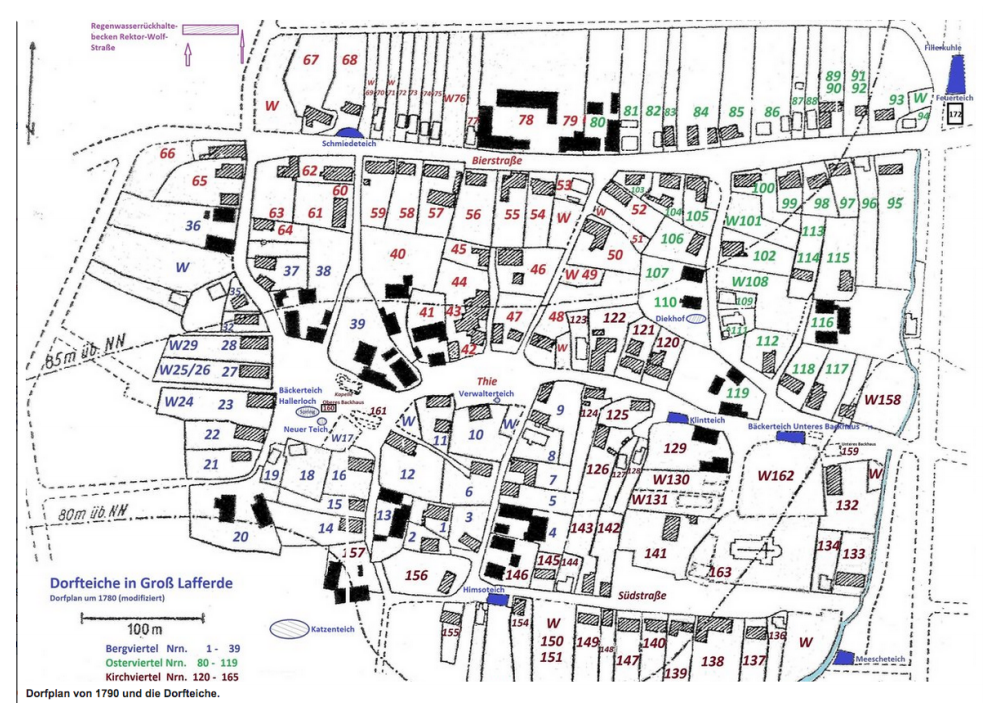
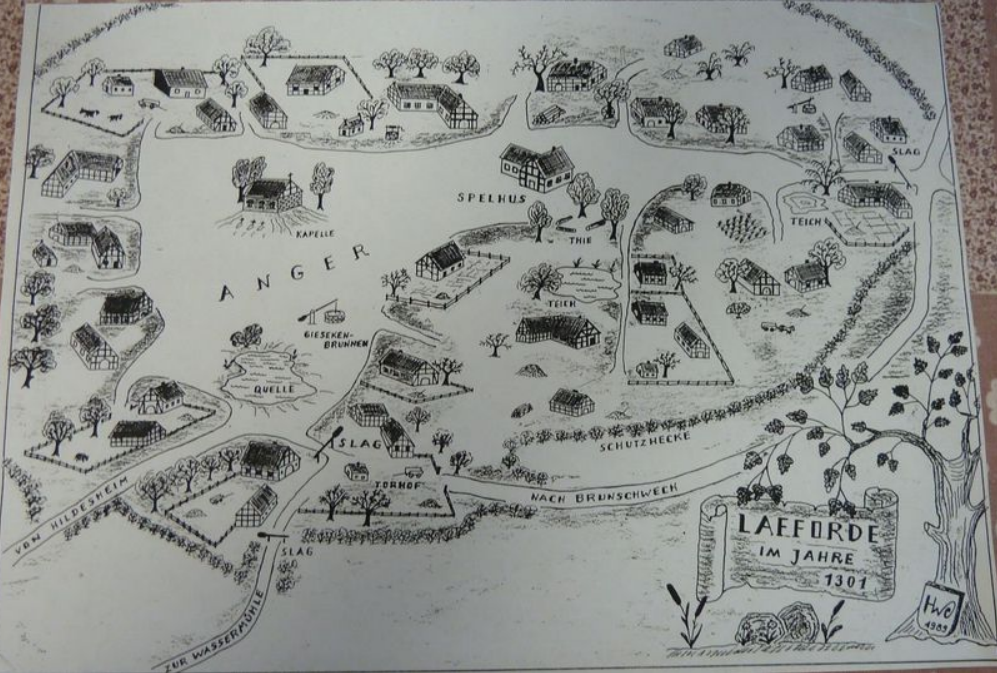
The ancient Germanic tribes held groves and springs sacred, which is why they liked to choose these places for their settlements. In Lafferde there was once such a sacred spring, whose water poured into a neighbouring pond for centuries. This spring is located behind the former upper bakery.10 Although it is no longer recognisable in its former state, an old well with the municipal pump and the so-called „Gieseckenbrunnen“11 still receive their water from here today.
The first settlements (the later Meierhöfe) were therefore probably those farms that were located near the holy spring. According to Nülle, these were followed by the farms in the Sack, in the Winkel, near the chapel and the farms between Taternstraße and the cemetery on the one hand, and Südstraße and Breite Straße on the other.12
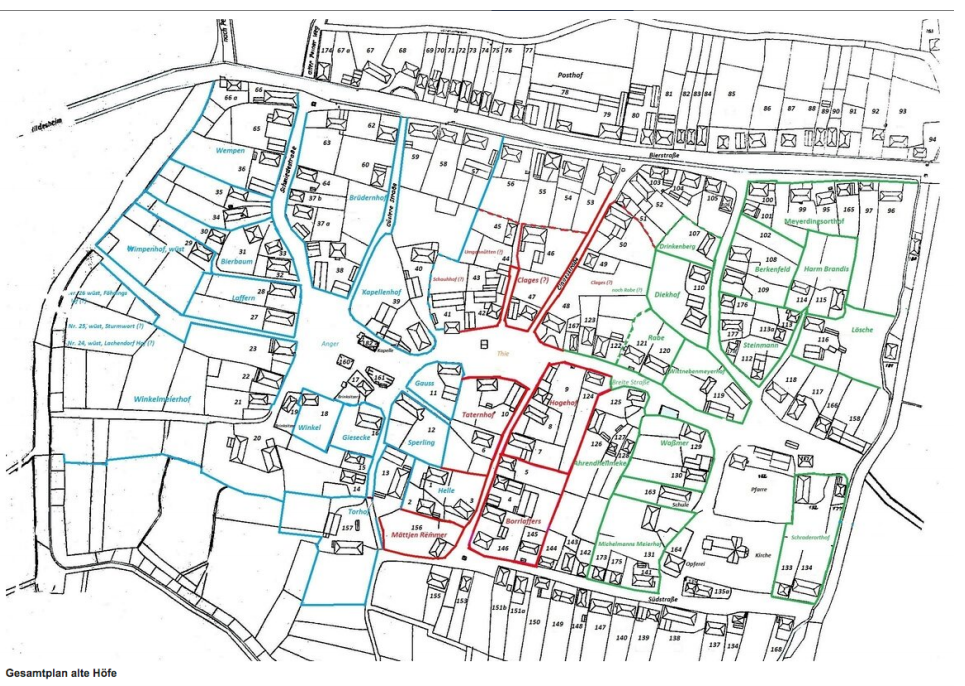
The main development of these larger farms was probably completed around 1300. They undoubtedly included the former Burgdorff Meierhof No. 38, which was located next to the Capellenhof and was a considerable full farm with its 5 hooves of arable land (hence the descriptor „Vollspänner“), a large meadow and the right to use 6 acres of bush wood (Allmende13).
According to Nülle, in the municipal archives, the courtyard and its garden extended from the open space on the south side (once Jahnplatz) to the field path “behind the gardens” (today Bierstraße). To the west, the main path into the field (today Schmiedesträße) bounded the courtyard, and to the east, the Düstere Straße,14 which was laid out between the courtyard garden and the Capellenhof, certainly formed the boundary.
The first change to the farm, after the property was secured by leasehold, was the cession of the farmstead on the corner of Schmiedesträße and Bierstraße (No. 63 Unverzagt = 31st Beibauerstelle15). This was probably soon followed by the separation of the farmstead at the corner of Düstere Straße and Bierstraße (No. 62 Lampe, which was called a small farmstead in 1773). After that, the farmsteads Nos. 37 and 37a (Meyer, Wittenberg = Kotstelle) emerged from the main farmstead. This was probably followed by the creation of farmstead No. 60 (Möhle/Burgdorff, which was a small farmstead in 1773). Such separations, known as village extensions, became necessary over time for almost all farms in the village because the second and third sons also had to be provided with residences. They then had to provide for the acquisition (enfeoffment) of farmland themselves. Often, however, the parent farm also gave them a few pieces of arable land in order to create the economic basis for a Kleinköther, Halbkotsaß or Brinksitzer.16 In the 18th century house registers, these smaller owners are mostly referred to as „Beibauern“. Around 1770, there were 51 such farms in Groß Lafferde (see „Die Bauern und Hausbesitzer im Kreise Peine“, Goslar 1938). Most of the full and three-quarter Vollspänner farms from 1300 have become smaller as a result of these foundations. Around 1800, only two full Vollspänner (No. 38, 79), two three-quarter Vollspänner (=Dreiviertelspänner) (No. 20, 119) and seven half Vollspänner (Halbspänner) (No. 4, 39, 57, 110, 116, 146 and 157) are still listed in the village.
Only the Burgdorff farm at No. 38 does not appear to have changed its old ownership status significantly when the farmsteads were established. In a record from 1769, the farm is listed with 122½ Morgen of land. The court chamber of the prince-bishop in Hildesheim is named as the owner of 114½ Morgen of meierland. Furthermore, the cathedral chapter is listed as the owner of 4½ Morgen of land, the Kreuzstift with 3 Morgen of Meierding’s17 land and the Michaeliskloster with ½ Morgen of hereditary interest land.
Farm No. 38, with its more than 4 hooves, has thus remained a full Vollspänner throughout the centuries.
With regard to the Brüdernhof, it should be noted that Heinrich vom Damme certainly visited his feudal leaseholder18 during his stay in Lafferde and possibly enquired about his concerns; see also Part 3.
Changing Feudal Lords in the 14th and 15th Centuries
In these two centuries, the landlord relationships in the villages of the diocese of Hildesheim were characterised by frequent changes of ownership, feudal enfeoffments, pledges and redemptions. This was due to the pressing financial needs of the clerical and aristocratic lords of the monastery caused by their numerous feuds — especially with the neighbouring dukes of Brunswick19-Wolfenbüttel. When they were overburdened with debt as a result of the war campaigns, they simply mortgaged the land of their peasants, who thus became the main victims of their feudal lords’ military conflicts.
Unfortunately, these fief changes, which are often handed down in incomplete documents, can only rarely be related to a single farm. Until the beginning of the 14th century, only the size and location of an estate were usually specified (e.g. „use fyf hufe, de belegen un buwet (bebauet) synt to groten Lafforde“, or „all use gut, tyns (Zinsen) un de Lude (Leute) to groten Lafforde“ — translation: “five hooves operated in Groß Lafferde” and “all their goods, interest and people of Groß Lafferde”).
Only gradually was the name of the respective tenant mentioned, initially only with the first name, later also with the surnames that were emerging at the time. Only the feudal lords and perhaps witnesses present were always mentioned by name when changes in ownership occurred.
The history of the „Brüdernhof“ in Groß Lafferde
The Brüdernhof becomes the Sprengerhof — Bad times for Lafferde farmers
In 1301 we hear that Bishop Siegfried enfeoffed the Villicus Hermann zu Lafferde with an allodium (Meierhof). This must have been the „Brüdernhof”, as the bishop had been the feudal lord of this farm since time immemorial, as already stated earlier.
Around 1400, the five hooves of the Brüdernhof were in the feudal possession of Heinrich vom Damme in Hildesheim (from Blume: Zur Geschichte Hildesheimer Ortschaften, 32).
However, this feudal owner must have initially had difficulties because of his rights, because in a letter dated 1400 the council of the town of Hildesheim asked Bishop Johann III to urge his bailiff Mattenloz in Peine to return confiscated goods in Lafferde to the citizen Heinrich vom Damme (Doebner: Urkundenbuch der Stadt Hildesheim). The fact that he was a respected “citizen” of his town can be seen from a town account from 1409 (Doebner p. 368). It says: „Hans Vernevessen und Hinrik vom Damme (haben) mit den deneren verdan to lafferde, do se met unses Herren amzluden gereden weren — 39 S, 4d.“ This means that he was with Hans Vernevessen and a number of armed town servants (deneren) on one of the then customary day trips to the Speelhause in Gr. Lafferde (now the site of the water tower20) to negotiate (gereden weren) with the officials (amz-luden) of our lord (bishop). In terms of expenses for himself and his men (for horse and rider), he spent (owed) the considerable sum of more than 39 shillings in travelling expenses.
As far as the Brüdernhof is concerned, it should be noted that Heinrich vom Damme certainly visited his vassal once during his stay in Lafferde and possibly enquired about his worries.
He then only had the farm until 1452, because in a document from that year Bishop Magnus enfeoffed the brothers Hans, Hermann and Gerhard Sprenger in Hildesheim with five hooves and a Meierhof in Groß Lafferde, which Heinrich vom Damme had previously held in fief (Doebner: Urkundenbuch). A second feoffment deed from 1453 is related to this and states: “1453, on the Sunday after Trinity: Bishop Bernard gives Hans Sprengern of Hildesheim a feudal charter for five hooves of land and a Meierhof in Großlafferde, which he had already received as a fief from Bishop Magnus (1424–1452) (Bernard’s predecessor). He pays 21 shillings for it”.
The Sprengers then owned the Brüdernhof in Gr. Lafferde for well over 100 years. We therefore call it the “Sprengerhof” for this period.
The Sprengers were a highly respected and influential patrician family in Hildesheim. One member of the family, the mayor Hermann Sprenger, was particularly important for the town. It was he who implemented the Reformation in Hildesheim in 1542. In August of that year, he and some like-minded councillors rode to Brunswick via Lafferde, where they rested in the “Speelhause”, to recruit the first Protestant preachers. The Duke and the city gave him Dr Johannes Bugenhagen, Magister Winckel and Magister Anton Corvinus for a short period of time. Sprenger returned with them to Hildesheim via Lafferde on 31 August, and the very next day the first Protestant service was held in St Andrew’s Church.
The “Sprengerhof” is frequently mentioned in the records of Hildesheim Cathedral Abbey from 1453 onwards.
As early as 1459, Bishop Ernestus renewed the fief issued by his predecessor in 1453.
In 1469, “the Hildesheim citizens and cousins Hermann and Hans Sprenger sold a resaleable annuity from their Fünfhufenhof (the five hooves farm) in Gr. Lafferde”.
In 1475, Heinrich, Bishop of Hildesheim, issues the same fief to Hans Sprenger in Groß Lafferde. In 1481 it says: “On the Sunday after Sinte,21 Barthold issued Hans Sprenger, son of Harmen Sprenger, with the same feudal charter”.
In 1492, it was Bishop Magnus who “on Sunday in the Hilgen Vasten22 issued a fiefdom and feudal charter for five hooves of land and a farm in Gr. Lafferde, currently owned by Hermann Holland, to the brothers Hermann and Gherde Sprenger for 21 shillings”.
In 1505,23 “on the Monday after Sunday Laetare in den hilgen Vasten, Bishop Johann then issues the feudal charter to Hans Sprenger, Hermann’s son”.
Plundering and Fire
With this enfeoffment, the Brüdernhof and the village entered a terrible century. After decades of peace and prosperity, it brought the first battles of the Reformation and bloody feuds between the monastery nobility and the bishop and his allies. Plundering, burnt farms and devastated fields were the signs of the times.
Did Hans Sprenger, the new feudal lord of the Brüdernhof, realise this? He must have reckoned with upcoming financial difficulties, because just three years later, “1508, Monday after Laetare,24” “Johann Bishop of Hildesheim and Duke of Saxony, gives his consent that the aforementioned Hans Sprenger may transfer and pledge the fiefs before Gr. Lafferde”. With this, the bishop will certainly have complied with a precautionary request from his vassal, because soon afterwards significant changes in ownership occurred in Gr. Lafferde, which lies on the border between Hildesheim and Braunschweig.
“Dean Johann of St. Blasiusstift zu Braunschweig confesses on Midweken in den Paschen 1516 (26 March) that his chapter had bought the remaining tithes of Lafferde for 1500 guilders (one Guilder 20 groschen)”. The village was thus now partly aligned to Braunschweig and partly to Hildesheim.
However, the dukes of Brunswick and the prince-bishop of Hildesheim had been at loggerheads for a long time and a bloody feud was imminent. This meant that the farms of the border town, including of course the Brüdernhof, were facing hard times.
The devastating war broke out in 1519 and has gone down in history as the “Great Abbey Feud”.
Even before the outbreak of war in 1518, the rowdy Burchard von Saldern invaded the monastery in order to inflict as much damage as possible on the bishops. The villages of Lafferde, Elvede (Dingelbe) and Schellerten went up in flames. The Brüdernhof, because it belonged to the bishop, was one of the first to have the red rooster on its roof.25 Even “the fimmen (straw stalks) in the field outside Lafferde” were burnt.
The history of the „Brüdernhof“ in Groß Lafferde (IV)
Bloody wars destroyed the village — The “Sprengerhof” becomes the “Brüdernhof” again — the feudal owners change
A year later, it was Duke Henry the Younger who undertook a “burning and plundering campaign against Hildesheim” from the Lange Wiese (between Bettmar and Lafferde26). When he failed to take the fortified town by surprise, he retreated back to the Lange Wiese in anger. He camped here for 14 days, during which time he caused the villages of Gr. Lafferde, Kl. Lafferde and Münstedt to go up in flames.
And a little later it says: “Duke Henry of Brunswick invaded the courts of Peina and Steinbrück and acted quite ruthlessly, plundering, devastating and burning many beautiful villages there.”
Hardly rebuilt, the people of Lafferde met with misfortune once again in 1521 when Steinbrück Castle was destroyed: “The people of Brunswick came with their wagon castle, 5,000 strong, and set up camp in Groten Lafferde. An alarm was sounded, but the storm remained that day. But early the next Monday they stormed and killed them all. Hans Barner (captain of the bishop’s castle) also remained on duty at St Mary’s.”
“The next day, when the Steinbrück was taken, those of Brunswick moved back to Groten Lafferde.” Presumably, however, all the farmhouses there lay in ruins, because “the princes had to camp in the open field.” Before they moved on, “they buried twenty men in a field who had been killed close to Steinbrück.”
After the departure of these armies, the farmers stood before the ruins of their houses, completely impoverished. Only when the final peace treaty was signed in Quedlinburg27 in 1523 following a truce between the warring parties in Lafferde, the farmers could begin to rebuild their destroyed farms and recover from the horrors of the unfortunate feud.
This took many years, and during this time the feudal lords probably had to forego their annual income from the farms. The Brüdernhof was probably also unable to pay its dues to the Sprenger family in Hildesheim.
The Sprengers had also become impoverished in the meantime. In 1544, Mayor Sprenger had to sell his large house in the Langen Hagen in Hildesheim (it is said to have been the largest in the city at the time) due to lack of money. After demolishing this house, the brewers built their brewers’ guild house and the famous wedding house on the site, where from then on the large weddings of wealthy families were celebrated.
A few years later, on St Michael’s Day 1549, the Sprenger family also lost the Brüdernhof in Gr. Lafferde: “Hermann Sprenger, a citizen of Hildesheim, borrowed 600 guilders from Schwarzen Albrecht of Wolfenbüttel and pledged his Meyerhof and 5 hooves of land in and outside Lafferde.” The Sprengers do not appear to have redeemed it again after this. Although the farm is mentioned once again in 1567 as a fief of the Sprenger family, it then passes to Asche von Holle, the bishop’s bailiff in Peine at the time. This means that the “Sprengerhof” has once again become the Brüdernhof. We hear of it again in 1598, when it changes hands once more.
Two documents provide information about this:
- A letter from Archbishop Ernst to his Drosten v. Münnighausen (v. Münchhausen)
- A letter from v. Münnighausen to his bailiff v. Hoya in Peine
They serve the notary Henricus Luheken28 as a document for the following “instrumentum in missiones” (deed in accordance with a commission), which he draws up on 11 February 1598 at the Brüdernhof in Gr. Lafferde: “The Droste Hans von Münnighausen of Steuerwald Castle requests the bailiff of Peyna, Albrecht von Hoya, to represent him in the matter in question: On 8 August 1593, the Archbishop of Cölln (currently also Bishop of Hildesheim) enfeoffed Albrecht Buschen, Doctor of Laws and Councillor and Chancellery Administrator of the Abbey of Hildesheim, with the Sprengersche Hofe, which was last held by von Holler (bailiff of Holle) and is now still held by his widow. Albrecht Buschen is to be instructed in such a way that he is to possess, use and have the farm with its pertinences (accessories) as a fief after the death of the aforementioned widow.”
The induction of the new fiefdom owner Buschen then takes place in a rather impressive manner. Notary Luheken writes: “The bailiff of Hoya handed Dr A. Busch the bolt of the gates, standing next to the gate, at the vorbemeltem hove29 and instructed him with words in realem possessionem (into real possession). Busch cut a spike from the gate pillar for further evidence. After this had been done, the above-mentioned gentlemen went into the field to the lands belonging to the farm („hove“), where the lord bailiff also took up a clod of earth from the ground and gave it to the lord doctor with the declaration that he will have exequiret (executed) and carried out his received command with it. All of which the Herr Doctos per lactum in vine et effective adeztal possessionis acceptiret (i.e. according to the meaning: over a drink of wine he effectively accepted the received possession). Witnesses to the instrument: Joachim Ploster, bailiff of the house of Peina, Curdt Unverzagte, Gogreve, Ludichen Roßain, sub-bailiff of Laferde.” (Cathedral chapter H., 2938 a)
It is striking that the current owner, i.e. farmer resp. peasant, of the Brüdernhof does not appear to have been present at this enfeoffment, which was certainly important for the future, nor is he mentioned by name. It proves how little the feudal farmers were regarded by their feudal lords at that time.
The history of the „Brüdernhof“ in Groß Lafferde (V)
Around 1600, the „Brüdernhof“ becomes the ancestral home of the Lafferder Burgdorffs
A large family tree in the hallway of the Brüdernhof traces the Burgdorff family back to the year 993. In that year, King Otto III had “summoned the nobles of the surrounding area to settle border issues with them” at the imperial palace in Werla. Among the nobles present was Adelbard (Alard) v. Dörnten.
This Adelhard can probably be regarded as the progenitor of the Burgdorf(f) family, which is still widespread in the Harz foreland today, as his descendants, of whom the brothers Arnold and Lüdiger von Thornthusen (v. Dörnten) are named in 1133 (Urkundenbuch der Stadt Goslar, Band 1/184), built a fortified castle in the 12th century at the centre of their possessions near Burgdorf,30 which is situated close to Dörnten. They gave up the name v. Dörnten and took the surname v. Burgdorf after their new residence.
This can also be seen in two other documents from the years 1142 and 1151 (Urkundenbuch Vol. 1/196 and 212). The brothers Arnold and Lüdiger are no longer called v. Dörnten, but v. Burgdorf.
Rise and Fall
31The dynasty of v. Burgdorf rose to prominence in the following period. The Burgdorfs often appear as participants in the historical sources of the Harz from the early Middle Ages or are named as witnesses in documents of secular and ecclesiastical lords. They also distinguished themselves as ministers of the realm and achieved great renown and significant wealth. However, the splendour of the dynasty was not to last long. The line descended from Arnold von Burgdorf in particular soon experienced a certain downgrading. Due to the power struggles of the then Emperor Barbarossa, they came under the sovereignty of Duke Henry the Lion and lost their previous prominent position as imperial ministers. As part of the duke’s entourage, the v. Burgdorfs, like many regional knights, took part in the countless feuds of the time, and as a result their fortunes became increasingly poor. They sold or mortgaged one valuable family estate after another and by the fourth generation after Henry the Lion they were completely absorbed into the dukes’ service. From their formerly favoured position, they sank back into the propertyless, lower nobility and were henceforth dependent on remuneration for the services they rendered to the duke.
Dietrich v. Borchtorp becomes Bailiff of Woltwiesche
According to a document from 1320, Dietrich von Borchtorpe32 becomes the princely Brunswick-Lüneburg bailiff of Woltwiesche (Hoogeweg: Urkundenbuch des Hochstifts Hildesheim, Vol. 4 / 576).
This Dietrich can probably be regarded as the progenitor of the Woltwiescher, Groß Lafferder, Söhlder, Lengeder — and probably also the Lesser — Burgdorfs.
In addition to his bailiwick, he was given a ducal Meierhof (later house No. 19 in Woltwiesche) and thus became a farmer. His descendants will very soon have given up the aristocratic name, which no longer corresponded to their new status, and simply called themselves Borchtorp (Burgdorf).33
There is no information about the Woltwiescher Burgdorfs until 1540. Then, in the inheritance registers of the Lichtenberg office, the first Woltwiesche farm appears as a Meierhof belonging to Hennig Burgdorf. It comprises four and a half hooves and it also remains a Burgdorfs farm in the later registers (1566 Hermann, 1579 Heinrich, 1593 Adam).
The Burgdorf(f)s in Groß Lafferde
In the second half of the 16th century, the Burgdorf(f)s also appear in Groß Lafferde for the first time. As early as 1548, a Barthold is mentioned as having to pay a Freihuhn34 and 20 shillings of Turkish treasury to the Wolfenbüttel authorities. In 1567 and 1573, Heinrich Burgdorf is mentioned as the owner of three hooves and six acres of hereditary land. In 1585, his son Barthold donated one Vorling (½ Morgen) for the future maintenance of the Groß Lafferder school founded that year by Pastor Cordes.
Unfortunately, it is no longer possible to determine whether and when all the Burgdorfs came from Woltwiesche and whether they already owned the „Brüdernhof”. This can only be ascertained from the Groß Lafferdern church records, which begin around 1650.35 Among the first entries there is a Hans Burgdorf (born 1576, died 1651) from Woltwiesche. The fact that he came from the original farm (No. 19) in Woltwiesche, perhaps as the second or third son, is proven by a grain annuity that he was entitled to from this farm. For a number of years he received two bushels and eight Himpten36 of rye and two bushels and four Himpten of oats annually from Woltwiesche. This must have been the dowry with which he was compensated by his father’s farm according to the custom of the time. His direct descendants still live on the „Brüdernhof” today, and the other Lafferder Burgdorffs who come from this farm can also claim Hans Burgdorf as their progenitor.
The „Brüdernhof“ during the Thirty Years’ War
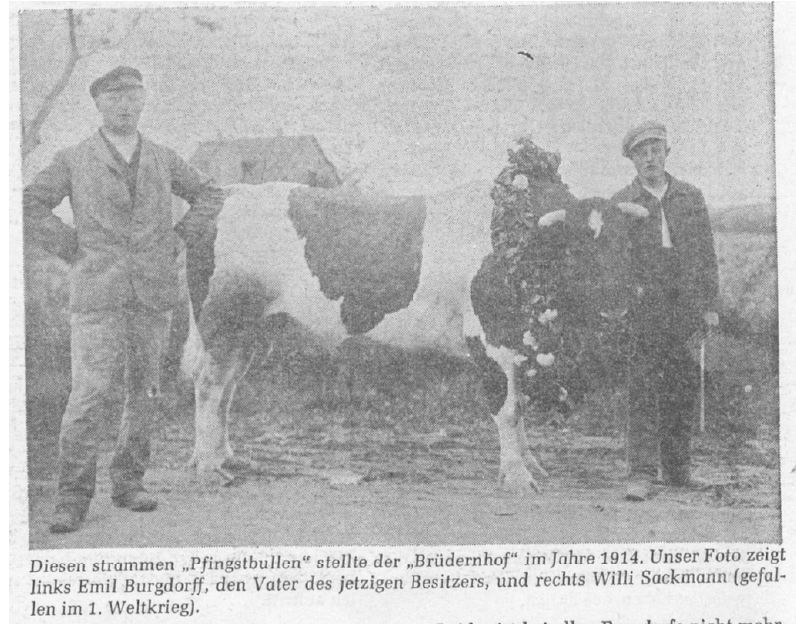
Heinrich (or Hennig) Burgdorf, Hans’ eldest son and heir, was born in 1607. He died in 1677. In 1634 he is mentioned as Vollspänner in Groß Lafferde and in the baptismal register of 1615 he is expressly described as „Villicus und Hauswirth“ (= owner of a Meierhof).
The history of the „Brüdernhof“ in Gr. Lafferde (VI)
Around 1800: Already 40 Burgdorff families — They already made up a large part of the population 200 years ago
These two Burgdorfs (Heinrich resp. Hans) had to carry the „Brüdernhof” through the Thirty Years’ War with all its horrors. In the winter of 1626/27, the Imperial General Tilly set up camp on the „Langen Wiese“ near Groß Lafferde and completely plundered the village. During the conquest and destruction of Steinbrück Castle, the village was also razed to the ground. Wild hordes of lansquenets pillaged the defenceless inhabitants. Two years later, in 1629, the plague ravaged the village, and in 1641 the place went up in flames again.
The fate of the Burgdorff farm in these years is not known in detail. However, the owners must have been completely impoverished, because two years after the war Heinrich still had no barn and on 28 May 1650 applied to St Michael’s Monastery in Hildesheim to “rent the chapel at Groß Lafferde cheaply” in order to “store his grain in it”. The death register from 1667 records his death as follows: “As he sank into the grave, our large bell unfortunately burst.”
The next heir to the farm was Hans Burgdorf (born 1639, died 1684). In 1666, at the age of 27, he married Tilge Büttigers, a sister of the then pastor in Gr. Lafferde. As one of the pastor’s sons was the founder of the later Posthof, this marriage marked the beginning of the close family ties between the two largest farms in the village, the Brüdernhof and the Posthof.37
The marriage lasted only 18 years. “Hans Borchtoff, a landlord of 45 years, died on 21 July 1684”. His eldest son and heir, Hinrich (born 1668, died 1737) was only 16 years old when his father died. Nevertheless, the farm must have prospered, because as early as 1690 the monastery decreed that the two farms in Lafferde (Capellenhof and Brüdernhof), which had been exempt from taxes since 1654 due to their poverty, had to pay the previously waived castle feast services again. How high the other levies were can be seen from a grain register of St Michael’s Monastery, in which a Meyerhof in Gr. Lafferde comparable to the Brüdernhof is assessed.
It states: “The Meyerhof with its 3½ hooves of land pays interest annually: 32 bushels of rye, 16 bushels of barley, 48 bushels of oats (according to the monastery measure), as well as 4 Groschen for travelling expenses incurred by the fiefdom owner (except during harvesting time), 1 goose, 2 chickens, 60 eggs and around the 9th year 10 Thaler for the renewal of the Meyerbrief, plus 1 Spezies-Thaler 12 Groschen (for) writing fees.”
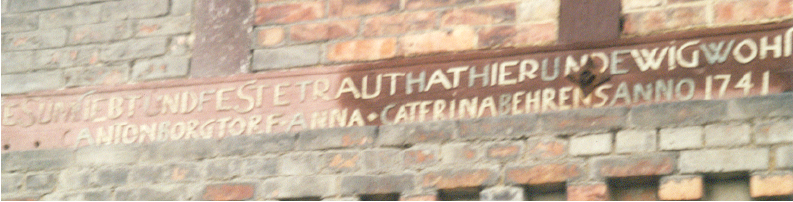
Hinrich Burgdorff was followed by Johann Anton (gen. Tönies), born 1696, deceased 1757 and Johann Hinrich, born in 1733, died in 1816. Inscriptions on some of the farm buildings they erected date from their lifetimes:
He who loves Jesus and firmly trusts,
has built well here and forever.
Anton Borgtorf + Anna Catharina Behrens.
Anno 1741
This inscription can still be read today on the sill timber in the half-timbered structure of the stable building on Dunkle Straße.
Hinrich Borgtorff + Margaretha Ilseken Brandes.
MDCCL XXIX (1779)
This inscription stood on the gable above the gate of the old barn until 1904. This barn is also mentioned in a letter from the “High Princely Office of Peine” dated 15 December 1779: “The farmer Joh. Heinrich Burchdorff is acknowledged to have built a new barn, 90 feet long and 50 feet wide, worth 600 Rthl. according to the Brandkasse”. The letter refers to the fire insurance fund founded two years earlier (today’s Landschaftl. Brandkasse), in which all houses were registered and insured according to the house numbers which are still in use today.
The first fire register of the municipality established at that time is still available in the municipal archives. The Burgdorff farm was given „Hsnr. 38 im Berg-Vierthel“38 and was assessed with an insured value of 1125 Thalers. An annual premium of 1 Thl. and 9 Gutegroschen39 had to be paid.
From this old list of house numbers it can be seen that there were now 15 families with the name Burgdorff in Gr. Lafferde: Vollspänner, Halbspänner, Vollköther or Kotsassen, Halbköther, Kleinköther and Brinksitzer, 50 years later there were even 40 Burgdorffs, who with their family members probably made up a large proportion of the inhabitants of Gr. Lafferde.
The history of the „Brüdernhof“ in Gr. Lafferde (conclusion)
A Burgdorff becomes Canton-Maire — Administrative expert in the Kingdom of Westphalia / The old tradition is still cultivated
The first half of the 19th century at the Brüdernhof was characterised by Johann Heinrich Andreas Burgdorff, who was born in 1761 and died in 1842. He was a highly respected man and served the community — under four different sovereigns — for many years.
Until secularisation in 1803, Gr. Lafferde was subject to the prince-bishopric of Hildesheim. This was followed by the Prussian period until 1807, the Westphalian period until 1813 (under Jérome40) and then the Hanoverian period.41
In the Kingdom of Westphalia, the village became the capital of a canton (supra-local administrative district) in the Braunschweig district of the Oker department. The canton also included Kl. Lafferde, Münstedt, Gadenstedt, Oberg, Gr. Ilsede and Lengede.
Johann Heinrich (Andreas) Burgdorff became “Canton-Maire” and in this capacity had great authority. The office is comparable to that of a later Prussian district administrator („Landrat“).42 All the “Bauermeister” (mayors) in his district were subject to him and had to follow his orders. The “Canton-Maire” was also a justice of the peace. For his official duties he had “an office, a court house, a civil prison and a registry” at his disposal in Gr. Lafferde.
Johann Heinrich Andreas Burgdorff must have proved himself as an administrator, because after the end of the Westphalian period in 1815 he was not dismissed as a friend of the French, but was immediately appointed by the Royal Great-British-Hanoverian government as Amtsvoigt of the “I. Amtsvoigtey im Kgl. Amte Peine“43 overseeing the communities of Gr. and Kl. Lafferde, Lengede, Münstedt and Dungelbeck. The municipal archives still contain numerous circular decrees that he issued as guardian of the authorities. His manner of expression and writing style show that he had successfully developed from a simple farmer into an educated administrator.
A special entry in the church register reports on his death: “When our old bailiff was at the Amtsstube44 in Peine, he was suddenly struck by a stroke, whereupon he died after a few days on 26 February 1842 at the age of 80 years, 9 months and 16 days. At his grave stood a family of eight children (one daughter and seven sons), 52 grandchildren and 12 great-grandchildren.”45
In the obituary of a family member it says: “The deceased was a highly respected man throughout his life and was honoured by all sides as the patriarch of the Burgdorff family of Gr. Lafferde until old age.” His eight children all remained connected to the farming community. His oldest son Wilhelm inherited (as a nephew) the neighbouring farm No. 40, Christian inherited farm No. 119 (arable farm) from his uncle, Christian Schwalenberg,46 Leopold became leaseholder of the Lauenthal mill, Daniel Brinksitzer at No. 144 and leaseholder of the Steinbrück mill.47 Finally, Julius became the owner of a merchant’s shop at No. 172, while Carl-Emil married to Kl. Lafferde and became the ancestor of the Kl. Lafferder Burgdorffs as mill and farm owner. Their only daughter, Dorothea, married Wilhelm Böttcher, the last postmaster of Gr. Lafferde and owner of the Posthof. She became a farmer’s wife48 on the largest farm in the village.
The Burgdorffs 120 years ago
In the main house No. 38 there is a large village map from the middle of the last century (1858), in which all the Burgdorffs descending from the Brüdernhof and living in Gr. Lafferde at that time are listed:
| House No. | Farm type | Owner |
|---|---|---|
| 38 | Vollspänner | Ferdinand Burgdorff |
| 119 | Dreiviertelspänner (three-quarter) | Carl Burgdorff |
| 40 | Viertelspänner (quarter) | Wilhelm Burgdorff |
| 11 | Kotsaß | Carl Burgdorff |
| 22 | Kotsaß | Heinrich Burgdorff |
| 33 | Kotsaß | Heinrich Burgdorff |
| 52 | Kotsaß | Julius Burgdorff |
| 68 | Kotsaß | Christian Burgdorff |
| 86 | Kotsaß | Carl Burgdorff |
| 99 | Kotsaß | Christian Burgdorff |
| 138 | Kotsaß | Carl Burgdorff |
| 8 | Brinksitzer | Jacob Burgdorff |
| 31 | Brinksitzer | Conrad Burgdorff |
| 72 | Brinksitzer | Heinrich Burgdorff |
| 73 | Brinksitzer | Friedrich Burgdorff |
| 144 | Brinksitzer | Daniel Burgdorff |
| 174 | Brinksitzer | Heinrich Burgdorff |
| 181 | Brinksitzer | Heinrich Burgdorff |
| 179 | Brinksitzer | Heinrich’s heirs |
The Successors to the Amtsvoigt
The old Amtsvoigt was succeeded on the Brüdernhof by three owners with the first name Ferdinand, which has been popular in the family ever since:
- Vollspänner Peter Ferdinand (1793-1861)
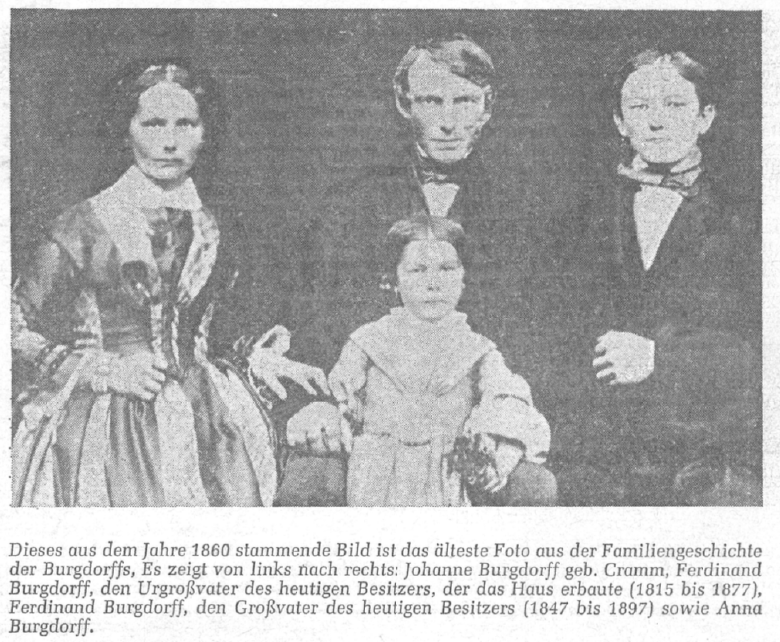
- Vollspänner Ferdinand (1815-1877)
- Vollspänner Ferdinand (1847-1897)
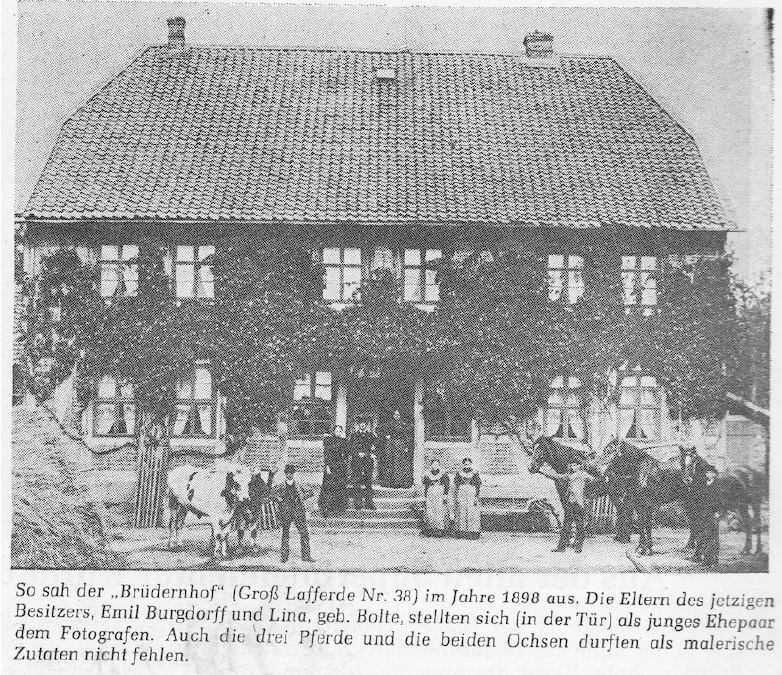
The current house was built in 1854. The half-timbered barn on the west side, which dated back to 1779, burnt down but was rebuilt immediately and now had solid walls. The stable building on the east side was demolished in 1885 and rebuilt with a solid substructure. A small, additional residential building, which was used as a residence for the elderly, was also built at that time. It was only demolished a few years ago.
And these are the owners of the farm in the 20th century: Emil Burgdorff (1877-1933), still remembered by many residents as the long-standing chairman of the warriors’ association. Ferdinand, born in 1911, took over the farm from him and passed it on to his son Ferdinand, born in 1942. Together with Anna Burgdorff, a sister of the current owner, these two bearers of an old tradition maintain the legacy of a long line of ancestors and an old farming family.
The history of this farm, firmly rooted in its homeland for hundreds of years, reflects Peine’s local history, and the old saying may also apply here: As long as the oaks continue to grow in their old vigour around the farm and house, the old tribal species will not die out in Lower Saxony!