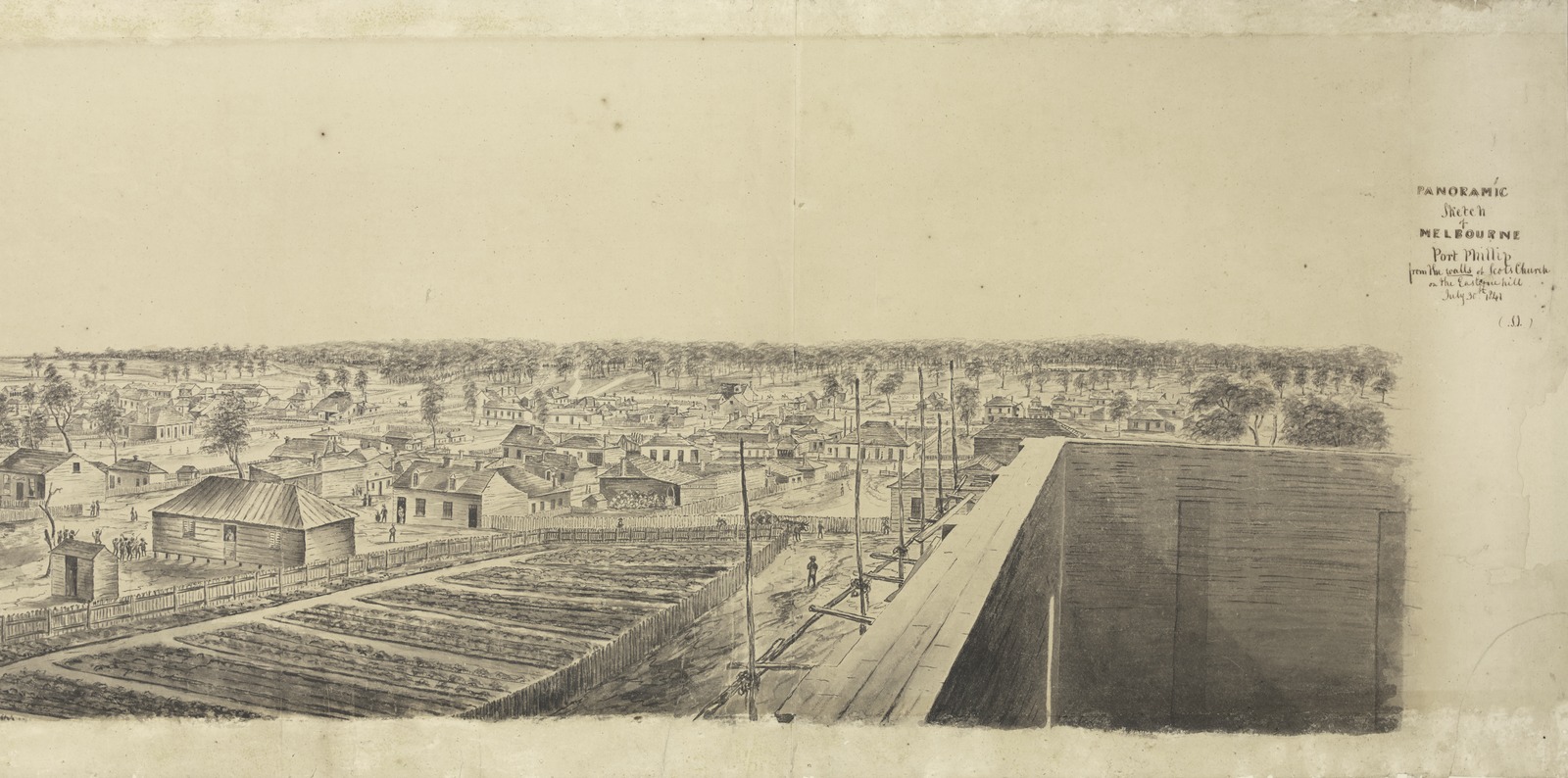
When the bounty immigrant barque Middlesex dropped anchor at Hobsons Bay on 1 October 1841, my great-great-grandparents, James and Elizabeth Gorey, faced an immediate trial of endurance.
The four-month voyage from Plymouth had already been incredibly taxing; Elizabeth had given birth to their eldest son, Michael, at sea just as the ship neared the Australian coastline. Stepping onto the muddy banks of the Yarra River with a newborn, they entered a settlement that was structurally and financially struggling.
Melbourne was barely six years old, with a permanent population of around 5000 people. The town’s foundational rivalry between its co-founders, the late John Batman and the outspoken John Pascoe Fawkner, had left a legacy of rapid, speculative growth, but that speculative bubble had just burst. Capital from Britain had dried up, banks were collapsing, and the town was sliding into a deep economic depression.
The physical infrastructure was practically non-existent. There were no permanent bridges across the Yarra, meaning crossings required paying for private rowboats or using unstable, primitive punts.
The streets were unpaved dirt tracks that turned into deep, axle-snapping quagmires after rain. Because government bounty ships were discharging thousands of working-class settlers into a market with plunging wages and zero available housing, more than a thousand new arrivals were forced to live out of a makeshift canvas tent city on the south bank of the Yarra.
Politically, the town was simmering with resentment. The Port Phillip District was still governed entirely from Sydney, hundreds of miles away. Local settlers constantly railed against the New South Wales administration for siphoning off local land revenues to fund Sydney infrastructure while leaving Melbourne completely neglected.
To fulfill the terms of their bounty passage, the Goreys had to move immediately away from the urban grid toward the heavily timbered country east at Bulleen and Templestowe to find agricultural work.
This landscape was the ancestral home of the Wurundjeri people. For millennia, the wetlands and lagoons, most notably Bolin Lagoon (Lake Bulleen), had been a vital resource, providing seasonal catches of fish and waterbirds while serving as a crucial meeting place for Kulin nation clans.
The Goreys arrived at the exact moment this ancient dynamic was being systematically dismantled. In 1841, Superintendent Charles La Trobe directed the local Aboriginal Protector to forcibly keep the local Indigenous population away from the newly surveyed private land blocks in Heidelberg and Bulleen, closing off access to the river flats forever. As James and Elizabeth began navigating the district as hired laborers, they would have lived alongside this ongoing frontier friction.
As Irish Catholic immigrants, James and Elizabeth also belonged to a distinct social minority, making up roughly 20-25 per cent of a predominantly Anglo-Protestant colony. Their faith served as both a core identity and a practical survival network.
When they landed, the local Catholic pioneer leader, Father Patrick Geoghegan, was celebrating Mass in a primitive, unroofed timber "Mass House" at the corner of Elizabeth and Lonsdale Streets while building slowly got under way on St Francis' Church.
The raw, precarious nature of their first decade in the colony is underscored by the birth of their daughter Mary on 5 March 1846. Family tradition notes she was born in a tent pitched at Templestowe, revealing that even five years after landing, permanent housing was still a luxury.
In 1840s Victoria, raising a family in camp conditions was a dangerous lottery; infant mortality was devastatingly high, with between 10-15 per cent of all children dying before their first birthday due to waterborne illnesses and exposure to extreme weather.
When James and Elizabeth took baby Mary to be baptised on 19 October 1846, they walked into the completed St Francis’ Church, which had been blessed the year before.
The sheer distance from the bush and the linguistic barrier left a classic piece of clerical history on the record: the parish clerk, struggling to interpret the parents' Irish accents, phonetically recorded their home as "Idle Burgh, parish of Buller" (Heidelberg, Bulleen).
By the late 1840s, the family’s work clearing dense timber with crosscut saws began to stabilise.
Their frontier life intersected with Australian literary history. A family recollection notes that they knew a young Thomas Alexander Browne, later famous as the novelist "Rolf Boldrewood," author of Robbery Under Arms.
Before heading inland in 1844, a teenage Browne lived directly across the Yarra River at his family's grand estate, "Hartlands" in Eaglemont. Riding along the flats and waiting at the local punt, the young future author regularly crossed paths with the enterprising sawyers and small-scale farmers like James Gorey, quietly absorbing the authentic colonial characters who would later populate his classic Australian tales.
From tenant farmers to landowners
By the time my great-grandfather Edward Gorey was born in late 1849, the family was moving into formal tenant farming. In March 1851, James officially secured a seven-year lease on Farm 24 of the Carlton Estate (managed by speculator James Atkinson).
The property was a substantial 97 acres of highly fertile, alluvial soil with direct Yarra River frontage, extending across the site where the Bulleen Brickworks would later stand. The annual rent was a steep £40, a significant financial commitment.
Just months after signing the lease, two massive events transformed their world forever. First, on 1 July 1851, the Port Phillip District officially won its long political battle and separated from New South Wales, birthing the independent Colony of Victoria. Weeks later, gold was discovered.
The quiet pastoral outpost suddenly experienced a demographic tsunami. Immigration numbers exploded from a slow trickle of a few thousand a year to a chaotic influx of over 80,000 arrivals annually.
While fields across Victoria were abandoned by labourers rushing to the diggings, James made a calculated choice to stay on the Yarra flats. He chose market stability over the lottery of prospecting, recognising that the thousands of incoming diggers created an insatiable demand for basic food supplies.
By keeping his head down and utilising horse-drawn plows to keep 90 of his 97 acres under intense potato and cereal cultivation, James systematically capitalised on the massive gold rush food inflation.
It was this steady farming income, rather than a lucky strike with a pick-axe, that gave him the liquid capital to walk into the Malmsbury land sales in April 1855 and drop over £1200 in cash to buy their own freehold farm on the Campaspe River.
The year 1857 marked the bittersweet end of their 16-year chapter on the Yarra flats. The Carlton Estate was being prepared for subdivision sale, and the Goreys were finally ready to claim their permanent freehold home.
But the departure was heavily tinged with grief. That final year in Bulleen, their young son William passed away and was laid to rest in the nearby Heidelberg soil. When James, Elizabeth, and the children finally packed their wagons to head up the road to Malmsbury, they left a piece of their hearts behind in the valley.
Moving their working stock, possession, and heavy farming implements over 120km northwest along Mount Alexander Road, before the arrival of the railway, was a brutal, dusty physical challenge.
They travelled surrounded by transient prospectors, but they moved with a very different purpose.
They departed no longer as the penniless bounty immigrants who had stepped off a wooden ship with a newborn baby during a colonial depression, but as independent, self-made freeholders who had used quiet persistence and practical economic choices to carve out a permanent future in the new colony.
Pictured top: Melbourne from the walls of Scots Church on the Eastern Hill, 30 July 1841, just before the Goreys arrived in the colony.